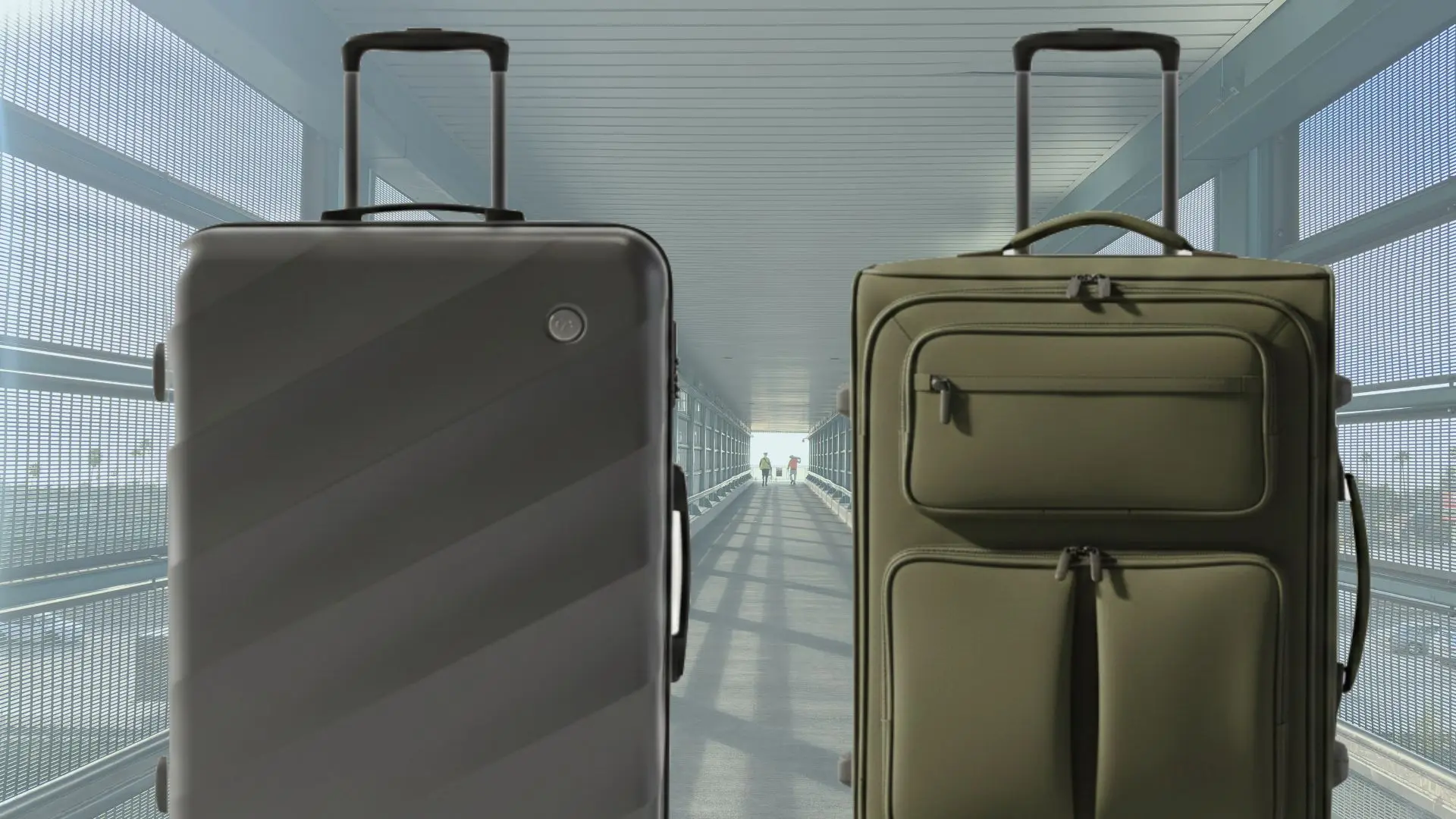
A carry-on is your most important piece of gear. Unlike checked bags that are handled by machines and ramp agents, your carry-on is your constant companion through terminals, security lines, and tight overhead bins.
The material you choose dictates how you pack, how much you can fit, and how well your belongings are protected.
The Hard Shell Bag
Hard shell suitcases, typically made of polycarbonate, ABS, or aluminum, have seen a massive surge in popularity thanks to their sleek design, modern aestheti,c and improved durability.
The Pros: Protection and Security
The primary advantage of a hard shell is protection. If you are traveling with fragile items, electronics, or camera gear, the rigid exterior acts as a shield against the bumps and shoves of travel.
Additionally, hard shells are almost always water-resistant. If you’re walking through a rainy city to get to your hotel, your clothes inside will stay bone-dry.
Security is another win for the hard shell camp. Most come with integrated TSA-approved locks, and because the sides are rigid, they are much harder slit open with a blade compared to fabric.
The Cons: No Flexibility
The biggest downside to a hard shell is its lack of "give." If the overhead bin is tight, a hard shell won't compress to fit.
You also lose out on external pockets. Most hard shells require you to open the entire "clamshell" (splitting the bag in half) just to grab a pair of headphones or a passport.
The Soft Shell Bag
Soft-sided bags are usually made of fabrics like ballistic nylon or polyester. They are the classic choice because they are incredibly forgiving!
Note: Have a soft-shell bag? Use our "soft bag" toggle to account for the luggage's ability to compress! Check My Bag
The Pros: Pockets and Packing
The most loved feature of a soft shell bag is the external organization. Having 2–3 front pockets for your laptop, chargers, and liquids makes the security line a breeze. Furthermore, fabric has "give." If you overpack slightly, the fabric will stretch. If the overhead bin is almost full, you can often "squish" a soft shell into a space where a hard shell would be rejected.
Most soft shells also feature a "lid-open" design rather than a clamshell. This means you pack into one deep main compartment, which many travelers find easier for fitting bulkier items like boots or jackets.
The Cons: Harder to Clean
Soft-sided bags are more susceptible to wear, tears, and water absorption. If someone spills coffee on your bag in the lounge, or if it sits on a dirty terminal floor, it can be difficult to clean.
While high-quality nylon is water-resistant, it is not waterproof, and a heavy downpour can eventually seep through the seams.
Hard vs. Soft: The Direct Comparison
| Feature | Hard Shell | Soft Shell |
|---|---|---|
| Durability | High (Protects contents) | High (Resists scuffs) |
| Weight | Often lighter (Modern materials) | Can be heavier (Internal frames) |
| Exterior Pockets | Rare | Standard |
| Flexibility | None (Rigid) | High (Can be compressed) |
| Cleaning | Easy (Wipe and go) | Difficult (Requires scrubbing) |
Which Is Better for Frequent Flyers?
Frequent business travelers often prefer soft shell luggage for its accessibility and expandability. Being able to access items quickly from an exterior pocket or compress the bag slightly into a crowded overhead bin can be valuable during tight connections.
International travelers sometimes prefer hard shell luggage for its durability and added protection during longer trips or mixed transit conditions.
If you frequently fly budget airlines, flexibility may offer a slight advantage. Hard shells leave no margin for error. Soft shells provide a little forgiveness, but not immunity.
Ultimately, the airline’s carry-on dimensions matter more than the shell material.
Which One Should You Choose?
Pick a Hard Shell if:
- You carry fragile items or expensive electronics.
- You want a bag that is easy to keep clean and looks "new" longer.
- You prefer the security of a hardside lock and rigid exterior.
Pick a Soft Shell if:
- You like to pack last-minute souvenirs (the "squish" factor).
- You want quick-access pockets for your charger and travel documents.
- You often fly on smaller regional jets with tiny overhead bins.
Check Your Most Common Airline Limits Before Making Any Decision
Regardless of which material you choose, the most important rule of 2026 travel remains: Measure your bag before you get to the airport!
A soft shell that is bulging with extra clothes or a hard shell with protruding "spinner" wheels can both result in a gate-check fee.
Measure twice, buy once, and enjoy the flight!